
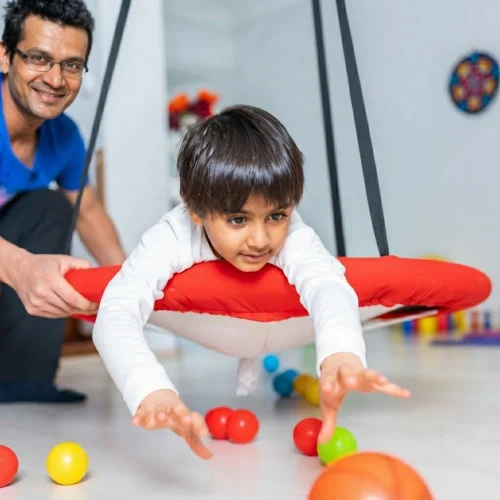
When a child struggles to hold a pencil, melts down over clothing tags or finds it hard to sit through a meal, parents often wonder whether it is a phase or something that needs support. Occupational therapy (OT) is one of the most practical answers. It focuses on helping people do the everyday things that matter to them and for children, that means playing, learning, eating, dressing and getting along with others.
This guide explains the main occupational therapy benefits, who can benefit, how it works and how it differs from physical therapy, so you can decide what is right for your family.
In short: The main benefits of occupational therapy for children are greater independence, better motor and handwriting skills, balanced sensory responses, stronger focus and self-regulation and higher confidence. Therapy works best when it starts early and parents practise the activities at home.
What Is Occupational Therapy?
Occupational therapy (OT) is a healthcare service that helps children build the skills they need for everyday life, such as playing, writing, eating, dressing and managing emotions. In OT, “occupation” does not only mean a job. It means any meaningful activity: for a child, that is playing, writing, feeding themselves and joining in at school.
An occupational therapist assesses what is getting in the way, then uses structured, goal-based activities to improve those skills. Occupational therapists are trained healthcare professionals and their work is guided by values such as client-centred care, respect for individuality and promoting independence.
What Are the Benefits of Occupational Therapy?
Is occupational therapy actually helpful?
Yes, for many children. The main benefits of occupational therapy are greater independence, better motor and handwriting skills, balanced sensory responses, stronger focus and improved social skills. Families see these gains when therapy is well matched to the child’s needs and practised consistently.
-
Greater independence in daily activities
The central aim of OT is independence. Therapy helps people manage tasks like dressing, bathing, eating, using the toilet and organizing their belongings. Even small gains, such as buttoning a shirt or using a spoon without help, build confidence and reduce the daily load on caregivers. -
Better fine motor and gross motor skills
OT strengthens the small muscles of the hands and fingers needed for writing, cutting and fastening, along with the coordination and balance needed for running, climbing and playing. Improved motor skills show up quickly in school and play. -
Improved handwriting and school performance
Children who find writing tiring or messy often benefit from help with grip, posture, hand strength and visual-motor coordination. Therapists also support attention, organization and classroom participation, which helps children keep up with their peers. -
Better sensory processing
Some children are over-sensitive to sounds, textures or movement, while others seek constant stimulation. Sensory-based OT helps the nervous system respond in a more balanced way, which can reduce meltdowns, avoidance and restlessness. -
Stronger focus, attention and self-regulation
Some children are over-sensitive to sounds, textures or movement, while others seek constant stimulation. Sensory-based OT helps the nervous system respond in a more balanced way, which can reduce meltdowns, avoidance and restlessness. -
Improved social and play skills
Play is how children learn. OT builds turn-taking, sharing, imitation and cooperative play, which supports friendships and emotional development. -
Higher confidence and emotional well-being
When daily tasks become easier, children feel more capable. That confidence often carries over into willingness to try new things, which is one of the most meaningful benefits of all. -
Support for parents and caregivers
Good OT does not stop at the session. Families receive practical strategies, home activities and guidance on adapting routines, so progress continues every day.
Benefits of Occupational Therapy for Children
Children are at the heart of what we do at Kidscape CDC, so it is worth looking closely at how OT supports them in particular.
In children, OT can help with:
- Delayed milestones in sitting, crawling, walking or using the hands
- Difficulty with self-care such as feeding, dressing and toileting
- Poor grip, messy handwriting or trouble with scissors
- Sensory sensitivities or sensory-seeking behaviour
- Trouble with attention, planning and following routines
- Challenges with play and peer interaction
Because young brains are highly adaptable, early support often makes a real difference. Starting therapy sooner gives children more time to build skills before gaps widen, though therapy can help at any age.
Who Can Benefit from Occupational Therapy?
Occupational therapy supports children from infancy through the teen years and Kidscape CDC specialises in children. Children who can benefit include:
- Infants and toddlers with developmental delays or early feeding and motor difficulties
- Preschoolers getting ready for school, with self-care, play or sensory challenges
- School-age children with learning, handwriting, attention or sensory difficulties
- Teenagers building independence and life skills
If a physical, developmental, sensory or cognitive challenge affects your child’s daily life, OT may help.
What Problems Do Occupational Therapists Help With?
Occupational therapists address a wide range of challenges, including:
- Difficulty with self-care and daily routines
- Weak hand strength and coordination
- Poor balance and body awareness
- Sensory over- or under-responsiveness
- Attention and organization problems
- Emotional regulation and coping difficulties
- Barriers in the home or school environment
How Occupational Therapy Works
Every OT journey is personal, but most follow a similar path.
Individualized evaluation
The therapist observes the person, speaks with parents or caregivers and may use standardized assessments to understand strengths, challenges and priorities.
Customized interventions
Based on the evaluation, the therapist designs activities targeted at the person’s specific goals. For children, these are usually play-based, so learning feels natural and enjoyable.
Goal setting and progress tracking
Therapists agree on clear, measurable goals with the family, such as “holds a pencil with a functional grip” or “dresses independently”. Progress is reviewed regularly and the plan is adjusted as the child grows.
Family and caregiver training
Therapy is most effective when it continues beyond the clinic. Parents learn simple home activities and routines that reinforce skills, so every day becomes part of the therapy.
Environmental modifications
Sometimes the best solution is changing the setting rather than the person. This can include adjusting seating, adding tools like pencil grips or organizing the home or classroom to reduce stress and support independence.
What Conditions Does Occupational Therapy Treat?
Occupational therapy is used to support children with many conditions, including:
- Developmental delays: support for missed or delayed milestones in motor, self-care and play skills.
- Autism spectrum disorder: help with sensory needs, routines, communication through play and daily living skills.
- ADHD: strategies for attention, impulse control, organization and self-regulation.
- Sensory processing challenges: therapy that helps children respond more comfortably to sensory input.
- Learning and handwriting difficulties: work on fine motor skills, visual-motor integration and school readiness.
- Neurological conditions: support for conditions such as cerebral palsy or after brain injury, focusing on function and independence.
- Physical trauma and chronic pain: rehabilitation after childhood injuries, plus strategies to manage pain and fatigue during daily activities.
- Emotional and behavioural challenges: tools for coping, anxiety and emotional regulation.
Signs Your Child May Need Occupational Therapy
Which patients need occupational therapy? Children do not need to have a diagnosis to benefit. Consider an assessment if your child:
- Avoids or struggles with drawing, writing, cutting or building toys
- Seems clumsy, trips often or avoids playground activities
- Is very sensitive to noise, clothing, food textures or touch
- Has frequent meltdowns that seem hard to explain
- Has difficulty with dressing, feeding or toileting for their age
- Finds it hard to focus, follow instructions or switch between tasks
- Has delayed developmental milestones
One sign on its own is not a cause for alarm. If several of these sound familiar, a professional assessment can give you clarity and a plan.
Occupational Therapy vs. Physical Therapy
Occupational therapy focuses on daily activities and independence, while physical therapy focuses on movement, strength and pain. Parents often confuse the two because they work in similar settings and often work together.
|
Aspect
|
Occupational Therapy
|
Physical Therapy
|
|---|---|---|
|
Main focus
|
Daily activities and independence
|
|
In simple terms, physical therapy helps the body move and occupational therapy helps the person use that movement in everyday life.
The two are not competitors. Children with cerebral palsy, developmental delay or other complex needs often receive OT, physical therapy and speech therapy together as one coordinated plan.
Frequently Asked Questions
What does an occupational therapist do?
An occupational therapist assesses challenges that affect daily life, then plans and delivers activities and strategies that build skills, improve independence and adapt the person’s environment.
Is an occupational therapist a doctor?
No. Occupational therapists are qualified healthcare professionals who complete a dedicated degree in occupational therapy. They are not medical doctors (MBBS), though they work closely with doctors, pediatricians and other specialists as part of a care team.
Is an occupational therapist a doctor in Kerala?
The position is the same in Kerala as elsewhere in India. Occupational therapists are allied healthcare professionals with specialist training, not medical doctors. Always check that your therapist holds a recognized qualification and registration.
How long does it take to see results from occupational therapy?
It depends on the child’s needs, how often therapy happens and how consistently skills are practised at home. Some families notice small changes within weeks, while larger goals take months. Your therapist will set realistic timelines after the initial assessment.
Can occupational therapy improve handwriting?
Yes. By building hand strength, grip, posture and visual-motor coordination, OT often leads to clearer, less tiring handwriting.
Does my child need a diagnosis to start occupational therapy?
No. A diagnosis is not required. If daily activities, learning or behaviour are being affected, an assessment can show whether OT would help.
Conclusion
Occupational therapy helps children gain independence, build confidence and take part fully in play, learning and everyday routines. From better motor skills and sensory balance to stronger focus and calmer routines, the benefits reach the whole family. Their real value shows when therapy is tailored to the child, practised consistently at home and started early enough to give them time to grow into their abilities.
Noticed signs that your child may need extra support? Explore our occupational therapy services at Kidscape CDC and discover how play-based, family-centred therapy can help your child thrive. Feel free to contact us anytime to talk about your child’s needs.

Dr. Hasneem PM
Dr. Hasneem PM is an occupational therapist and one of the Directors of Kidscape CDC who specializes in helping children build motor, sensory and daily living skills. With a Bachelor of Occupational Therapy and a Sensory Integration certification from the University of Southern California, she works on one core principle: children learn best through play and progress lasts when families are part of the process.